

Volume 7, Issue 1 (Continuously Updated 2024)
Func Disabil J 2024, 7(1): 0-0 |
Back to browse issues page




Download citation:
BibTeX | RIS | EndNote | Medlars | ProCite | Reference Manager | RefWorks
Send citation to:


BibTeX | RIS | EndNote | Medlars | ProCite | Reference Manager | RefWorks
Send citation to:
Jalilian M, Aminian G, Mahmoodi M. The Immediate Effect of Texture Foot Plate on Balance in Diabetic Patients With Neuropathy. Func Disabil J 2024; 7 (1)
URL: http://fdj.iums.ac.ir/article-1-270-en.html
URL: http://fdj.iums.ac.ir/article-1-270-en.html


1- General Rehabilitation Center, Red Crescent Society of Islamic Republic of Iran, Tehran, Iran.
2- Department of Orthotic and Prosthetic, School of Rehabilitation Sciences, University of Social Welfare and Rehabilitation Sciences, Tehran, Iran. ,gh.aminian@uswr.ac.ir
3- Department of Orthotic and Prosthetic, School of Rehabilitation Sciences, University of Social Welfare and Rehabilitation Sciences, Tehran, Iran.
2- Department of Orthotic and Prosthetic, School of Rehabilitation Sciences, University of Social Welfare and Rehabilitation Sciences, Tehran, Iran. ,
3- Department of Orthotic and Prosthetic, School of Rehabilitation Sciences, University of Social Welfare and Rehabilitation Sciences, Tehran, Iran.
Full-Text [PDF 909 kb]
(497 Downloads)
| Abstract (HTML) (1454 Views)
Full-Text: (16 Views)
Introduction
One of the most common metabolic disorder diseases in the world is high blood sugar, which usually becomes a chronic disorder [1]. This condition is caused by metabolic disorders of lipids, protein and carbohydrates, which have been very prevalent among adults during the last decades [1, 2]. Diabetes can have a destructive effect on the vascular and neural systems, which may lead to neuropathy [3]. This is the most common complication among these patients and can create serious challenges for these patients [3, 4]. According to recent reports from the International Diabetes Federation (IDF) in 2013, there were 382 million diabetic patients worldwide and it is anticipated to reach to 592 million in 2035 which is a great concern [5]. This association has also reported that around 11.4 million Iranian adult people over 45 years old were involved with diabetes in 2011 [6] and the result of one study in 2005 revealed that this disease has a 7.7% prevalence among Iranian people [6].
One study showed that approximately one-third of diabetic patients suffer from neuropathy [6]. Neuropathy is the progressive destruction of nerve fibers that disrupts the peripheral and motor nerve function which is the peripheral disorder that is more common than motor nerve in diabetic patients. Neuropathy is usually bilaterally in both limbs and involves different parts of the nervous system which causes damage to the sensory system of the body and increases postural sway, thus disturbing balance. Therefore, one of the vital complications of neuropathy is balance deficiency among these patients [7, 8]. This situation may cause different problems, such as falling, sores, fractures and injuries subsequently; caring programs are necessary and required for them.
In this line, another study stated that balance may be improved by enhancing proprioception in these diabetic patients caused by neuropathy [8]. Damage to proprioception can also lead to the loss of perception body situation in the environment and increase the number of their falling [7].
There are some orthotic treatments for diabetic patients, one of which is the full contact foot plate orthosis. This type of foot plate may be utilized to decrease the postural swing for patients with a balance disorder. [9-13]. The arch is a total contact element of this type of insole and has the potential to aid mechanical stability and optimize the number of cutaneous mechanoreceptors receiving afferent surface information and thus can improve balance [13]. The texture foot plate is another type of orthosis that has been considered for patients with balance disorder for proprioception strength during the last decades [15, 16]. Some studies showed that in people without diabetic neuropathy standing on a textured or raised surface can enhance the cutaneous stimulation and increase neural feedback from cutaneous receptors [17, 18]. The results of other studies showed that improving the sensory systems of the body through the insoles using the textured insole is effective in improving balance in this patient [15, 16].
Regarding the effect of these plates, the hypothesis is that protuberant spots (points) on the upper layer of plate may stimulate the mechanoreceptors of the plantar surface of the foot, thus increasing the number of inputs from the foot plantar [9-13]. The effect of this type of the plate on cognitive skills, such as erect standing, walking, and joint angle detection has been shown by one study [9]. The results of many studies also showed that the texture plates may be able to improve the somatic sensory feedbacks which may lead to improved balance in patients [15, 16]. Therefore, it seems that these plates are useful for diabetic patients with balance disorders. According to the investigations in this study, no study was found to evaluate the effect of these plates on diabetic patients with a balance disorder. Thus, this study was conducted to evaluate the immediate effect of texture plates on the static and dynamic balance of diabetic patients with neuropathy.
Materials and Methods
This is a single-group pre-test-post-test study. All diabetic patients (type II) who have been referred to Firoozgar Hospital and examined based on the Michigan questionnaire and clinical evaluation by an endocrine and metabolism specialist can participate in this study. The participants in this study were selected by simple convenience sampling approach in terms of inclusion criteria, including without any pathologic condition (sore) in the foot, without deformity or disorder in lower extremities and with diabetic neuropathy, which was recognized using the Michigan questionnaire by an endocrine and metabolism specialist. Then, 16 diabetic patients who had these criteria and were volunteers and signed the consent form recruited in this study.
Data collection
Demographic data were collected by routine questionnaires and interviews. The force plate (Kistler Instrument Corp) with 50×60 cm dimensions, 100 Hz frequencies, and 10 Hz filtering by default for data entering was applied for measuring the static balance. To evaluate dynamic balance, time up and go (TUG) test was utilized. Data gathering was performed in Javad Movafaghian Laburator.
Orthosis
The foot texture plate was fabricated according to the size and pattern of the foot for each participant from AVE material with shore A25. The protuberant spots were created by heating the foam of the upper surface of the foot plate with 1 mm height and nine numbers in one cm square.
Procedure
First of all, the validity and reliability of the force plate were evaluated using standard different weights tools to assess the static balance. The study was performed to assess static balance in four conditions, including shoe only/shoe with foot plate with open and closed eyes for each condition. All participants wore the same type of shoe (Allstars model with elastic lower layer 2.8 cm height, upper covering from cotton, and enough space for placing foot plate). Before the beginning, all participants walked for several minutes with this shoe to accommodate new shoes. Then, the tests were performed by forceplate, participants were standing on a force plate while the distance between two malleolus was equal to two-thirds of the distance between two anterior superior iliac spines [19]. This test took 30 s. Each static and dynamic balance test was repeated three times thus each participant was tested 12 times for the static balance test.
As mentioned previously, the TUG test was considered to evaluate the dynamic balance and performed in two conditions shoe only/shoe with foot plate with only open eyes [20].
Statistical tests
At first, the force plate data was entered into Excel software and then, using related formulas the measurements of the mean of swings, the distance of movement, and the velocity of motion of the center of pressure (COP) were obtained from raw data of the force plate as eventually were converted to the quantitative amount. The SPSS software, version 21 was utilized for the final analysis. For determining the normality of the amount of collected scores, the Kolmogorov–Smirnoff test was used. Then, the paired t-test was utilized to evaluate the means of dynamic balance between two dependent groups (shoe only/shoe with foot plate).
Results
The results of the Kolmogorov-Smirnov test showed that all variables are normal. In the present study, 16 people were evaluated in terms of the inclusion criteria and then entered into the study. The subjects were evaluated as open and closed eyes.
Participants
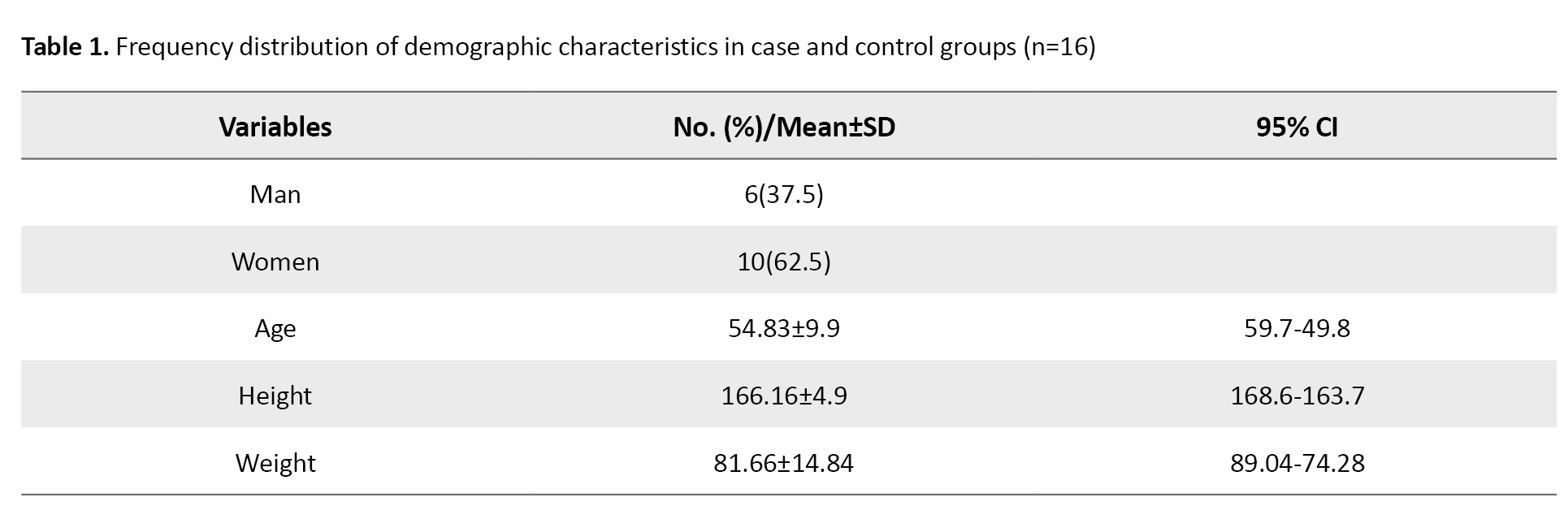
The distribution of gender variables among the subjects was 37.5% men and 62.5% women. Also, Table 1 presents the frequency distribution of demographic indicators, including gender, age, height and weight of participants.
Determination of static balance indices
The mean pressure center oscillation and displacement COP center and velocity of displacement of the COP were evaluated in people with diabetic neuropathic with and without textured insoles in open and closed eyes conditions.
The results of Table 2 show the determination of static balance indices in participants with and without textured insoles, with closed and open eyes.
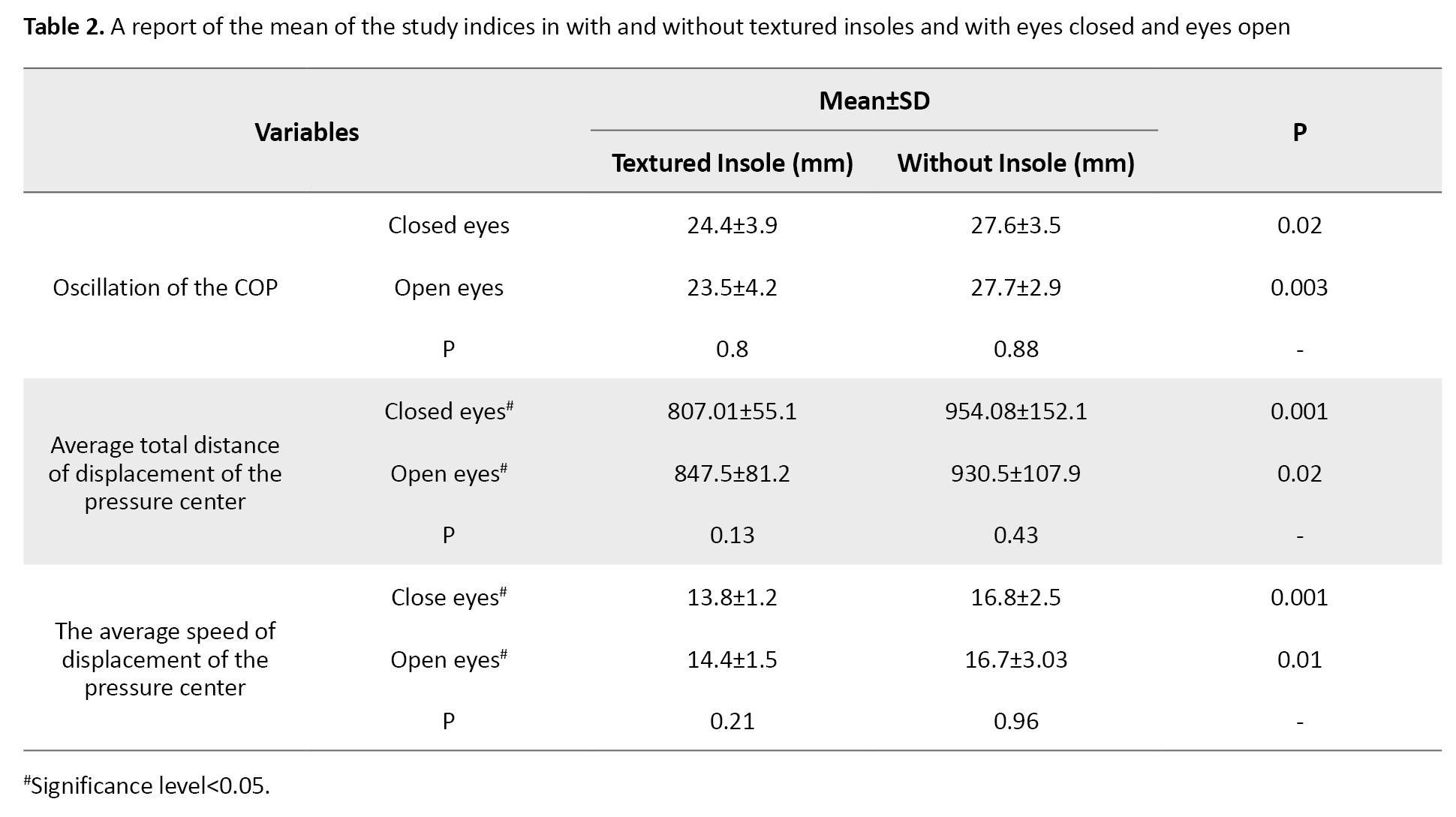
To compare the means in different conditions, paired t-test and independent t-test were used (due to the normality of the data). The results of Table 2 show that the average parameters mean pressure center oscillation (P=0.02 and 0.03 for closed and open eyes, respectively), displacement COP center (P=0.001 and 0.02 for closed and open eyes, respectively) and velocity of displacement of the COP (P=0.001 and 0.01 for closed and open eyes, respectively) in patients after the use of textured insoles has decreased significantly.
Table 2 presents the average parameters of pressure center oscillation and pressure center displacement and velocity.
Determination of dynamic balance
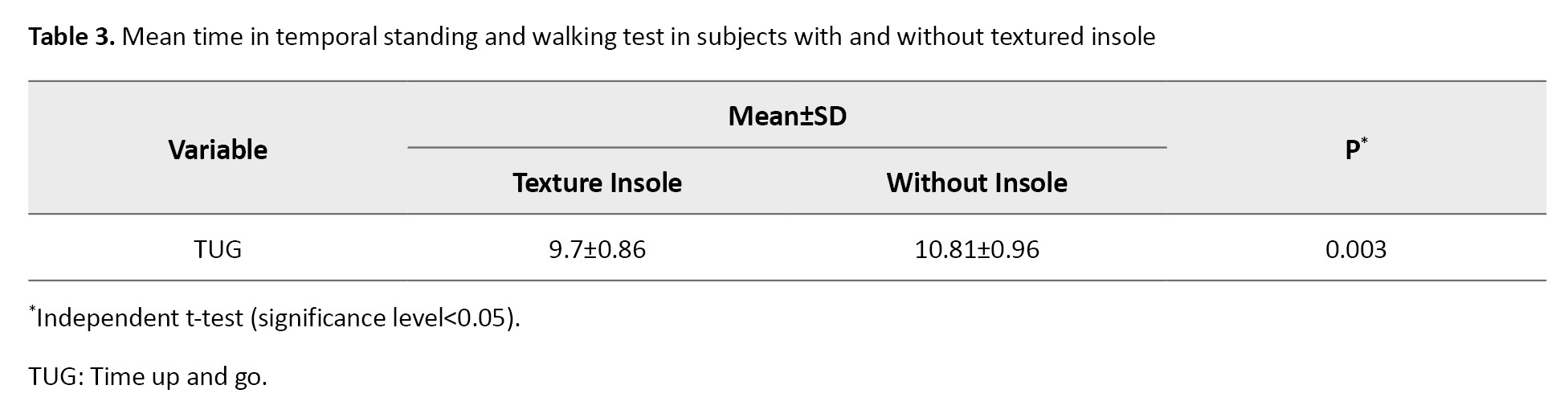
Table 3 presents the Mean±SD of the dynamic balance, according to these results, TUG test time was increased in the condition without textured insole.
Discussion
Static balance
This study was conducted to investigate the effect of textured insoles on the balance of people with diabetic neuropathy. According to studies on the static and dynamic balance of people with diabetic neuropathy, COP fluctuations in these people are associated with the severity of diabetes [9]. In the present study, the effect of the insole on the sensory-motor system was considered and it is assumed that the textured insole has a positive effect on reducing the risk factors for falling.
The degree of oscillation of the pressure center after using the textured insole in participants was significantly reduced, which may indicate an improvement in static balance in people with diabetic neuropathy. In this regard, Silva et al. examined the amplitude of displacement of the pressure center in the standing position. The results of this study reported a reduction in anterior-posterior oscillation of the COP in the closed eye condition within participants [7].
The results of the present study also showed a decrease in the COP displacement of people with diabetic neuropathy after using texture insoles which indicates the effectiveness of textured insoles in improving the static balance of people with diabetic neuropathy.
Other results of the recent study showed that the overall mean displacement of the pressure center in people with diabetic neuropathy decreased significantly after using textured insoles.
McKeon et al. found that the displacement of the COP decreased internally and externally in diabetic persons. The results of this recent study showed that changes in the center of longitudinal and transverse pressure reduced the stability of the ankle, resulting in stiffness and slowness of joint movements and impaired rhythm [22]. The results of Hatton et al.’s study on healthy middle-aged women also showed that by using texture insoles, the balance was increased in the internal-external direction in closed eyes conditions. The interpretation of these differences is that in the case of open eyes, the balance is easily maintained; therefore there is no need to use a textured surface. However, in the absence of visual feedback, balance information is obtained through the sensory system and foot receptors by using of texture insole [11].
According to the study of Allet et al. people with diabetic neuropathy had a severe decrease in deep feeling and it may be considered textured insoles for these people for possible effect on their deep sense. This means that this plate may have a positive role in positional stability and reduction of displacement of the pressure center [23].
In a study conducted by Jamali and Forghany, the effect of textured insoles on the balance of athletes with functional ankle instability was evaluated. The authors argued that people with ankle instability may be improved by sensory stimulation of the foot using this type of insole [24].
The results of the present study showed a significant reduction in pressure center displacement speed using texture insoles. This result also may indicate an improvement in static balance in people with diabetic neuropathy.
A study conducted in 2019 that investigated the effect of textured insoles on the speed of displacement of the COP reported small positive effects on the speed after using the insoles [25]. This result is consistent with the results of the present study, which is related to the effect of textured insoles on decreasing the speed of displacement of the COP and as a result improving the balance referred to it.
Dynamic balance
The results of the TUG test in this present study showed that after using the textured insole, the test time was reduced, which indicates an improvement in their dynamic and functional balance. The results of Simmons et al. indicated a significant decrease in functional balance in people with diabetic neuropathy compared to healthy individuals [26].
The present study showed that textured insoles improved dynamic and functional balance in patients with diabetic neuropathy. It is suggested that a more comprehensive study be conducted in the future and also implementing review studies in this field that compare all available insoles with each other. Other underlying variables, such as sex, age, weight, duration of illness and place of residence may be investigated in decreasing or increasing the amount of static and dynamic balance in people with diabetic neuropathy.
Conclusion
The results of the present study showed that after using textured insoles in people with diabetic neuropathy, the level of static and dynamic balance has improved in these people. Therefore, the use of textured insoles may be effective and considered in improving the balance of these people.
Ethical Considerations
Compliance with ethical guidelines
This study was approved by the Ethics Committee of the University of Social Welfare and Rehabilitation Sciences, Tehran, Iran (Code: IR.USWR.REC.1399.026).
Funding
The paper was extracted from the master's thesis of Masoud Jalilian, approved by the Department of Orthotics and Prosthetics, School of Rehabilitation Sciences, University of Social Welfare and Rehabilitation Sciences, Tehran, Iran.
Authors' contributions
Conceptualization and investigation: Masoud Jalilian; Supervision, Methodology and writing: Gholamreza Aminian and Maedeh Mahmoudi.
Conflict of interest
The authors declared no conflict of interest.
Acknowledgments
The authors express their gratitude to the Javad Movafaghian Laburator and also all persons who participated in this study.
References
One of the most common metabolic disorder diseases in the world is high blood sugar, which usually becomes a chronic disorder [1]. This condition is caused by metabolic disorders of lipids, protein and carbohydrates, which have been very prevalent among adults during the last decades [1, 2]. Diabetes can have a destructive effect on the vascular and neural systems, which may lead to neuropathy [3]. This is the most common complication among these patients and can create serious challenges for these patients [3, 4]. According to recent reports from the International Diabetes Federation (IDF) in 2013, there were 382 million diabetic patients worldwide and it is anticipated to reach to 592 million in 2035 which is a great concern [5]. This association has also reported that around 11.4 million Iranian adult people over 45 years old were involved with diabetes in 2011 [6] and the result of one study in 2005 revealed that this disease has a 7.7% prevalence among Iranian people [6].
One study showed that approximately one-third of diabetic patients suffer from neuropathy [6]. Neuropathy is the progressive destruction of nerve fibers that disrupts the peripheral and motor nerve function which is the peripheral disorder that is more common than motor nerve in diabetic patients. Neuropathy is usually bilaterally in both limbs and involves different parts of the nervous system which causes damage to the sensory system of the body and increases postural sway, thus disturbing balance. Therefore, one of the vital complications of neuropathy is balance deficiency among these patients [7, 8]. This situation may cause different problems, such as falling, sores, fractures and injuries subsequently; caring programs are necessary and required for them.
In this line, another study stated that balance may be improved by enhancing proprioception in these diabetic patients caused by neuropathy [8]. Damage to proprioception can also lead to the loss of perception body situation in the environment and increase the number of their falling [7].
There are some orthotic treatments for diabetic patients, one of which is the full contact foot plate orthosis. This type of foot plate may be utilized to decrease the postural swing for patients with a balance disorder. [9-13]. The arch is a total contact element of this type of insole and has the potential to aid mechanical stability and optimize the number of cutaneous mechanoreceptors receiving afferent surface information and thus can improve balance [13]. The texture foot plate is another type of orthosis that has been considered for patients with balance disorder for proprioception strength during the last decades [15, 16]. Some studies showed that in people without diabetic neuropathy standing on a textured or raised surface can enhance the cutaneous stimulation and increase neural feedback from cutaneous receptors [17, 18]. The results of other studies showed that improving the sensory systems of the body through the insoles using the textured insole is effective in improving balance in this patient [15, 16].
Regarding the effect of these plates, the hypothesis is that protuberant spots (points) on the upper layer of plate may stimulate the mechanoreceptors of the plantar surface of the foot, thus increasing the number of inputs from the foot plantar [9-13]. The effect of this type of the plate on cognitive skills, such as erect standing, walking, and joint angle detection has been shown by one study [9]. The results of many studies also showed that the texture plates may be able to improve the somatic sensory feedbacks which may lead to improved balance in patients [15, 16]. Therefore, it seems that these plates are useful for diabetic patients with balance disorders. According to the investigations in this study, no study was found to evaluate the effect of these plates on diabetic patients with a balance disorder. Thus, this study was conducted to evaluate the immediate effect of texture plates on the static and dynamic balance of diabetic patients with neuropathy.
Materials and Methods
This is a single-group pre-test-post-test study. All diabetic patients (type II) who have been referred to Firoozgar Hospital and examined based on the Michigan questionnaire and clinical evaluation by an endocrine and metabolism specialist can participate in this study. The participants in this study were selected by simple convenience sampling approach in terms of inclusion criteria, including without any pathologic condition (sore) in the foot, without deformity or disorder in lower extremities and with diabetic neuropathy, which was recognized using the Michigan questionnaire by an endocrine and metabolism specialist. Then, 16 diabetic patients who had these criteria and were volunteers and signed the consent form recruited in this study.
Data collection
Demographic data were collected by routine questionnaires and interviews. The force plate (Kistler Instrument Corp) with 50×60 cm dimensions, 100 Hz frequencies, and 10 Hz filtering by default for data entering was applied for measuring the static balance. To evaluate dynamic balance, time up and go (TUG) test was utilized. Data gathering was performed in Javad Movafaghian Laburator.
Orthosis
The foot texture plate was fabricated according to the size and pattern of the foot for each participant from AVE material with shore A25. The protuberant spots were created by heating the foam of the upper surface of the foot plate with 1 mm height and nine numbers in one cm square.
Procedure
First of all, the validity and reliability of the force plate were evaluated using standard different weights tools to assess the static balance. The study was performed to assess static balance in four conditions, including shoe only/shoe with foot plate with open and closed eyes for each condition. All participants wore the same type of shoe (Allstars model with elastic lower layer 2.8 cm height, upper covering from cotton, and enough space for placing foot plate). Before the beginning, all participants walked for several minutes with this shoe to accommodate new shoes. Then, the tests were performed by forceplate, participants were standing on a force plate while the distance between two malleolus was equal to two-thirds of the distance between two anterior superior iliac spines [19]. This test took 30 s. Each static and dynamic balance test was repeated three times thus each participant was tested 12 times for the static balance test.
As mentioned previously, the TUG test was considered to evaluate the dynamic balance and performed in two conditions shoe only/shoe with foot plate with only open eyes [20].
Statistical tests
At first, the force plate data was entered into Excel software and then, using related formulas the measurements of the mean of swings, the distance of movement, and the velocity of motion of the center of pressure (COP) were obtained from raw data of the force plate as eventually were converted to the quantitative amount. The SPSS software, version 21 was utilized for the final analysis. For determining the normality of the amount of collected scores, the Kolmogorov–Smirnoff test was used. Then, the paired t-test was utilized to evaluate the means of dynamic balance between two dependent groups (shoe only/shoe with foot plate).
Results
The results of the Kolmogorov-Smirnov test showed that all variables are normal. In the present study, 16 people were evaluated in terms of the inclusion criteria and then entered into the study. The subjects were evaluated as open and closed eyes.
Participants
The distribution of gender variables among the subjects was 37.5% men and 62.5% women. Also, Table 1 presents the frequency distribution of demographic indicators, including gender, age, height and weight of participants.
Determination of static balance indices
The mean pressure center oscillation and displacement COP center and velocity of displacement of the COP were evaluated in people with diabetic neuropathic with and without textured insoles in open and closed eyes conditions.
The results of Table 2 show the determination of static balance indices in participants with and without textured insoles, with closed and open eyes.
To compare the means in different conditions, paired t-test and independent t-test were used (due to the normality of the data). The results of Table 2 show that the average parameters mean pressure center oscillation (P=0.02 and 0.03 for closed and open eyes, respectively), displacement COP center (P=0.001 and 0.02 for closed and open eyes, respectively) and velocity of displacement of the COP (P=0.001 and 0.01 for closed and open eyes, respectively) in patients after the use of textured insoles has decreased significantly.
Table 2 presents the average parameters of pressure center oscillation and pressure center displacement and velocity.
Determination of dynamic balance
Table 3 presents the Mean±SD of the dynamic balance, according to these results, TUG test time was increased in the condition without textured insole.
Discussion
Static balance
This study was conducted to investigate the effect of textured insoles on the balance of people with diabetic neuropathy. According to studies on the static and dynamic balance of people with diabetic neuropathy, COP fluctuations in these people are associated with the severity of diabetes [9]. In the present study, the effect of the insole on the sensory-motor system was considered and it is assumed that the textured insole has a positive effect on reducing the risk factors for falling.
The degree of oscillation of the pressure center after using the textured insole in participants was significantly reduced, which may indicate an improvement in static balance in people with diabetic neuropathy. In this regard, Silva et al. examined the amplitude of displacement of the pressure center in the standing position. The results of this study reported a reduction in anterior-posterior oscillation of the COP in the closed eye condition within participants [7].
The results of the present study also showed a decrease in the COP displacement of people with diabetic neuropathy after using texture insoles which indicates the effectiveness of textured insoles in improving the static balance of people with diabetic neuropathy.
Other results of the recent study showed that the overall mean displacement of the pressure center in people with diabetic neuropathy decreased significantly after using textured insoles.
McKeon et al. found that the displacement of the COP decreased internally and externally in diabetic persons. The results of this recent study showed that changes in the center of longitudinal and transverse pressure reduced the stability of the ankle, resulting in stiffness and slowness of joint movements and impaired rhythm [22]. The results of Hatton et al.’s study on healthy middle-aged women also showed that by using texture insoles, the balance was increased in the internal-external direction in closed eyes conditions. The interpretation of these differences is that in the case of open eyes, the balance is easily maintained; therefore there is no need to use a textured surface. However, in the absence of visual feedback, balance information is obtained through the sensory system and foot receptors by using of texture insole [11].
According to the study of Allet et al. people with diabetic neuropathy had a severe decrease in deep feeling and it may be considered textured insoles for these people for possible effect on their deep sense. This means that this plate may have a positive role in positional stability and reduction of displacement of the pressure center [23].
In a study conducted by Jamali and Forghany, the effect of textured insoles on the balance of athletes with functional ankle instability was evaluated. The authors argued that people with ankle instability may be improved by sensory stimulation of the foot using this type of insole [24].
The results of the present study showed a significant reduction in pressure center displacement speed using texture insoles. This result also may indicate an improvement in static balance in people with diabetic neuropathy.
A study conducted in 2019 that investigated the effect of textured insoles on the speed of displacement of the COP reported small positive effects on the speed after using the insoles [25]. This result is consistent with the results of the present study, which is related to the effect of textured insoles on decreasing the speed of displacement of the COP and as a result improving the balance referred to it.
Dynamic balance
The results of the TUG test in this present study showed that after using the textured insole, the test time was reduced, which indicates an improvement in their dynamic and functional balance. The results of Simmons et al. indicated a significant decrease in functional balance in people with diabetic neuropathy compared to healthy individuals [26].
The present study showed that textured insoles improved dynamic and functional balance in patients with diabetic neuropathy. It is suggested that a more comprehensive study be conducted in the future and also implementing review studies in this field that compare all available insoles with each other. Other underlying variables, such as sex, age, weight, duration of illness and place of residence may be investigated in decreasing or increasing the amount of static and dynamic balance in people with diabetic neuropathy.
Conclusion
The results of the present study showed that after using textured insoles in people with diabetic neuropathy, the level of static and dynamic balance has improved in these people. Therefore, the use of textured insoles may be effective and considered in improving the balance of these people.
Ethical Considerations
Compliance with ethical guidelines
This study was approved by the Ethics Committee of the University of Social Welfare and Rehabilitation Sciences, Tehran, Iran (Code: IR.USWR.REC.1399.026).
Funding
The paper was extracted from the master's thesis of Masoud Jalilian, approved by the Department of Orthotics and Prosthetics, School of Rehabilitation Sciences, University of Social Welfare and Rehabilitation Sciences, Tehran, Iran.
Authors' contributions
Conceptualization and investigation: Masoud Jalilian; Supervision, Methodology and writing: Gholamreza Aminian and Maedeh Mahmoudi.
Conflict of interest
The authors declared no conflict of interest.
Acknowledgments
The authors express their gratitude to the Javad Movafaghian Laburator and also all persons who participated in this study.
References
- World Health Organization (WHO). Definition, diagnosis and classification of diabetes mellitus and its complications. Geneva:World Health Organizatio; 1999. [Link]
- Shaw JE, Sicree RA, Zimmet PZ. Global estimates of the prevalence of diabetes for 2010 and 2030. Diabetes Research and Clinical Practice. 2010; 87(1):4-14. [DOI:10.1016/j.diabres.2009.10.007]
- Díaz-Gerevini GT, Repossi G, Dain A, Tarres M, Das U, Eynard AR. Cognitive and motor perturbations in elderly with longstanding diabetes mellitus. Nutrition. 2014; 30(6):628-35. [DOI:10.1016/j.nut.2013.11.007]
- Control D, Group CTR. Effect of intensive diabetes management on macrovascular events and risk factors in the diabetes control and complications Trial. The American Journal of Cardiology. 1995; 75(14):894-903. [DOI:10.1016/S0002-9149(99)80683-3]
- Beagley J, Guariguata L, Weil C, Motala AA. Global estimates of undiagnosed diabetes in adults. Diabetes Research and Clinical Practice. 2014; 103(2):150-60. [DOI:10.1016/j.diabres.2013.11.001]
- Esteghamati A, Etemad K, Koohpayehzadeh J, Abbasi M, Meysamie A, Noshad S, et al. Trends in the prevalence of diabetes and impaired fasting glucose in association with obesity in Iran: 2005-2011. Diabetes Research and Clinical Practice. 2014; 103(2):319-27. [DOI:10.1016/j.diabres.2013.12.034]
- Silva P, Botelho PFFB, de Oliveira Guirro EC, Vaz MMO, de Abreu DCC. Long-term benefits of somatosensory training to improve balance of elderly with diabetes mellitus. Journal of Bodywork and Movement Therapies. 2015; 19(3):453-7. [DOI:10.1016/j.jbmt.2014.11.002]
- Kars H, Hijmans JM, Geertzen JH, Zijlstra W. The effect of reduced somatosensation on standing balance: A systematic review. Journal of Diabetes Science and Technology. 2009; 3(4):931-43. [DOI:10.1177/193229680900300441]
- Christovão TCL, Neto HP, Grecco LAC, Ferreira LAB, de Moura RCF, de Souza ME, et al. Effect of different insoles on postural balance: A systematic review. Journal of Physical Therapy Science. 2013; 25(10):1353-6. [DOI:10.1589/jpts.25.1353]
- Corbin DM, Hart JM, McKeon PO, Ingersoll CD, Hertel J. The effect of textured insoles on postural control in double and single limb stance. Journal of Sport Rehabilitation. 2007; 16(4):363-72. [DOI:10.1123/jsr.16.4.363]
- Hatton AL, Dixon J, Rome K, Martin D. Standing on textured surfaces: Effects on standing balance in healthy older adults. Age and Ageing. 2011; 40(3):363-8. [DOI:10.1093/ageing/afr026]
- Orth D, Davids K, Wheat J, Seifert L, Liukkonen J, Jaakkola T, et al. The role of textured material in supporting perceptual-motor functions. Plos One. 2013; 8(4):e60349. [DOI:10.1371/journal.pone.0060349]
- de Morais Barbosa C, Barros Bértolo M, Marques Neto JF, Bellini Coimbra I, Davitt M, de Paiva Magalhães E. The effect of foot orthoses on balance, foot pain and disability in elderly women with osteoporosis: A randomized clinical trial. Rheumatology. 2013; 52(3):515-22. [DOI:10.1093/rheumatology/kes300]
- Paton J, Glasser S, Collings R, Marsden J. Getting the right balance: Insole design alters the static balance of people with diabetes and neuropathy. Journal of Foot and Ankle Research. 2016; 9(1):40. [DOI:10.1186/s13047-016-0172-3]
- Priplata A, Niemi J, Salen M, Harry J, Lipsitz LA, Collins JJ. Noise-enhanced human balance control. Physical Review Letters. 2002; 89(23):238101. [DOI:10.1103/PhysRevLett.89.238101]
- Wu F, Wang R, Jin D, Hu X, Yang Y, Zhang J, et al. Effect of noise-enhanced on the balance control ability in older adults. In: Duffy VG, editor. Digital human modeling: First international conference on digital human modeling, ICDHM 2007, Held as Part of HCI International 2007, Beijing, China, July 22-27, 2007. Proceedings 1 2007. Berlin: Springer; 2007. [DOI:10.1007/978-3-540-73321-8_56]
- Kalron A, Pasitselsky D, Greenberg-Abrahami M, Achiron A. Do textured insoles affect postural control and spatiotemporal parameters of gait and plantar sensation in people with multiple sclerosis? PM & R. 2015; 7(1):17-25. [DOI:10.1016/j.pmrj.2014.08.942]
- Dixon J, Hatton AL, Robinson J, Gamesby-Iyayi H, Hodgson D, Rome K, et al. Effect of textured insoles on balance and gait in people with multiple sclerosis: An exploratory trial. Physiotherapy. 2014; 100(2):142-9. [DOI:10.1016/j.physio.2013.06.003]
- Preszner-Domjan A, Nagy E, Szíver E, Feher-Kiss A, Horvath G, Kranicz J. When does mechanical plantar stimulation promote sensory re-weighing: Standing on a firm or compliant surface? European Journal of Applied Physiology. 2012; 112(8):2979-87. [DOI:10.1007/s00421-011-2277-5]
- Vaz MM, Costa GC, Reis JG, Junior WM, de Paula FJ, Abreu DC. Postural control and functional strength in patients with type 2 diabetes mellitus with and without peripheral neuropathy. Archives of Physical Medicine and Rehabilitation. 2013; 94(12):2465-70. [DOI:10.1016/j.apmr.2013.06.007]
- Gutierrez EM, Helber MD, Dealva D, Ashton-Miller JA, Richardson JK. Mild diabetic neuropathy affects ankle motor function. Clinical Biomechanics. 2001; 16(6):522-8. [DOI:10.1016/S0268-0033(01)00034-1]
- McKeon PO, Stein AJ, Ingersoll CD, Hertel J. Altered plantar-receptor stimulation impairs postural control in those with chronic ankle instability. Journal of Sport Rehabilitation. 2012; 21(1):1-6. [DOI:10.1123/jsr.21.1.1]
- Allet L, Armand S, De Bie R, Golay A, Monnin D, Aminian K, et al. The gait and balance of patients with diabetes can be improved: A randomised controlled trial. Diabetologia. 2010; 53(3):458-66. [DOI:10.1007/s00125-009-1592-4]
- Jamali A, Forghany S. The effect oftextured insole on balance in peoplewith functional ankle instability. Journal of Research in Rehabilitation Sciences. 2014; 10(5):619-26. [DOI:10.22122/jrrs.v10i5.1996]
- Kenny RP, Atkinson G, Eaves DL, Martin D, Burn N, Dixon J. The effects of textured materials on static balance in healthy young and older adults: A systematic review with meta-analysis. Gait & Posture. 2019; 71:79-86. [DOI:10.1016/j.gaitpost.2019.04.017]
- Simmons RW, Richardson C, Pozos R. Postural stability of diabetic patients with and without cutaneous sensory deficit in the foot. Diabetes Research and Clinical Practice. 1997; 36(3):153-60. [DOI:10.1016/S0168-8227(97)00044-2]
Type of Study: Research |
Subject:
Prosthetics and Orthotics
Received: 2024/08/19 | Accepted: 2024/09/17 | Published: 2024/11/13
Received: 2024/08/19 | Accepted: 2024/09/17 | Published: 2024/11/13
Contact Information

All the work in this journal are licensed under a Creative Commons
ATTRIBUTION-NONCOMMERCIAL-SHAREALIKE 4.0
INTERNATIONAL International License.
Tehran Province, Tehran, District 3, Mirdamad Ave, Nezam Ave, School of Rehabilitation Science
Tel: +98 21 22228051-2 Ext: 180
Fax98 21 22220946
All the work in this journal are licensed under a Creative Commons
ATTRIBUTION-NONCOMMERCIAL-SHAREALIKE 4.0
INTERNATIONAL International License.