

Volume 8, Issue 1 (Continuously Updated 2025)
Func Disabil J 2025, 8(1): 0-0 |
Back to browse issues page




Download citation:
BibTeX | RIS | EndNote | Medlars | ProCite | Reference Manager | RefWorks
Send citation to:


BibTeX | RIS | EndNote | Medlars | ProCite | Reference Manager | RefWorks
Send citation to:
Mahmoudian K, Boroumand S. Assessment of Health Status Among Occupational Therapy Students. Func Disabil J 2025; 8 (1)
URL: http://fdj.iums.ac.ir/article-1-328-en.html
URL: http://fdj.iums.ac.ir/article-1-328-en.html


1- Department of Occupational Therapy, Rehabilitation Research Center, School of Rehabilitation Sciences, Iran University of Medical Sciences, Tehran, Iran.
2- Student Research Committee, Iran University of medical ScienceS, Tehran, Iran. ,Sa.boroumand@yahoo.com
2- Student Research Committee, Iran University of medical ScienceS, Tehran, Iran. ,
Full-Text [PDF 549 kb]
(200 Downloads)
| Abstract (HTML) (745 Views)
Full-Text: (156 Views)
Introduction
The issue of health has been a concern since the inception of humanity. Nonetheless, it has traditionally been considered primarily in physical terms, with less attention given to other dimensions, particularly mental health [1]. As a key indicator of overall community well-being, mental health plays a crucial role in ensuring the dynamism and efficiency of any society [2]. Mental health is defined as behavior that aligns with societal norms, recognition and acceptance of social realities, the ability to adapt to them, and the flourishing of innate talents [2]. Additionally, mental health encompasses feelings of well-being, self-efficacy, self-reliance, competitive capacity, and the actualization of one’s intellectual and emotional potential [3]. It can be influenced during different stages of life, including the university period, which is an exciting and challenging time for students [4]. Moreover, it often involves significant changes in social and personal relationships, making it a sensitive period for the young and productive workforce of any country. Due to the unique conditions of university life, including being away from family, entering a large and often stressful environment, facing economic problems, having insufficient income, doing heavy coursework, and participating in intense competition, students are prone to experiencing mental health challenges [5]. Furthermore, the unfamiliarity of many students with the university environment upon entry, a lack of interest in their field of study, and difficulty adapting to new social settings can lead to mental health issues and decreased academic performance [4].
Students in health professions, including those in occupational therapy (OT), face additional pressures from the hospital environment and the challenges of addressing patients’ issues [6]. OT focuses on the physical, cognitive, psychological, and social dimensions of individuals, making it one of the most effective yet challenging fields of rehabilitation [7]. The diversity of clients in OT clinics exposes students to various physical and mental stresses, thereby necessitating both strong physical and mental resilience [8]. In Iran, in addition to common challenges, OT students face other issues, such as the lack of a distinct professional identity within the healthcare team and insufficient recognition of their profession’s critical role in the health system, which can further complicate their practice [9]. Similar to future specialists responsible for promoting public health, these individuals need optimal mental health and self-reliance for proper academic performance and, subsequently, enhanced service delivery. Therefore, assessing their mental health status and identifying and mitigating factors that threaten their well-being are of great importance [10].
In recent years, numerous studies have assessed the mental health status of medical students in Iran using standardized tests, such as the Goldberg general health questionnaire (GHQ) and the symptom checklist. Dibajnia and Bakhtiari evaluated the mental health status of students at the School of Rehabilitation, Shahid Beheshti University, Iran, and found that 31.6% of them suffered from mental disorders [11]. Likewise, a study by Imani et al. on nursing students at Hormozgan University of Medical Sciences, Iran, revealed that 36.8% of the samples were identified as potentially having mental health disorders [12]. Similarly, Sedighi et al. examined the mental health status of medical students at Rafsanjan University of Medical Sciences, Iran, reporting that age, gender, and marital status did not significantly affect the students’ mental health scores [13]. A similar study on 29 OT students at the University of Texas, USA, demonstrated that 66.4% experienced high levels of stress and were negatively impacted by mental health factors [14]. To the best of our knowledge, no study has specifically examined the mental health status of OT students in Iran. Accordingly, given the importance of assessing the health of OT students as part of the medical community, this study aims to evaluate their mental health status and associated factors at Iran University of Medical Sciences.
Materials and Methods
After receiving approval from the Ethics Committee of Iran University of Medical Sciences, Tehran, Iran, this cross-sectional study was conducted among 96 OT students enrolled in the School of Rehabilitation Sciences at Iran University of Medical Sciences. The sample size was determined based on Equation 1:
1. n=(z2×σ2)/E2
and previous research [15]. The inclusion criterion included being a student of OT at Iran University of Medical Sciences. On the other hand, students unwilling to participate were excluded from the investigation. Participants in this study were undergraduate, Master, and PhD students enrolled in the 2022-2023 academic year. They were included in the study after receiving the necessary explanations about the research plan and providing informed consent. Then, the participants were given instructions on how to complete the demographic questionnaire and the 28-item general health questionnaire (GHQ-28), with either printed or electronic versions provided for data collection. Next, SPSS software, version 28, was used for data analysis. The necessary assumptions were examined before performing the statistical tests. Subsequently, a multiple linear regression model was applied to assess the relationship between GHQ-28 scores (the dependent variable) and age, gender, place of residence, internship experience, and employment status (independent variables). A significance level of 0.05 was considered for all tests.
Study instruments
The research instrument in this study was GHQ-28, originally developed by Goldberg in 1972. GHQ is a psychological screening tool used to identify individuals with potential psychological disorders. The original version of this questionnaire consisted of 60 items, which underwent multiple revisions, resulting in shorter versions with 12, 28, and 37 items. The GHQ-28 utilized in this study consists of 4 subscales, each containing 7 items, assessing somatic symptoms, anxiety and insomnia, social dysfunction, and severe depression. The scoring method for this questionnaire follows a 4-point Likert-type scale (0, 1, 2, 3), yielding a maximum score of 21 per subscale and 84 overall. Previous research demonstrated that the Likert-type scoring method is preferable and is widely applied in mental health assessments. This questionnaire was first translated into Persian by Noorbala et al. (1999), with its reliability and validity subsequently confirmed. They determined that at the optimal cutoff score of 23, the questionnaire exhibited a sensitivity of 70.5% and a specificity of 92.3%. Accordingly, individuals scoring 23 or below were classified as mentally healthy, while those scoring 24 or higher were considered at risk for psychological disorders. A cutoff score of 6 was applied for each subscale. According to this scoring method, higher scores indicate poorer mental health [16].
Results
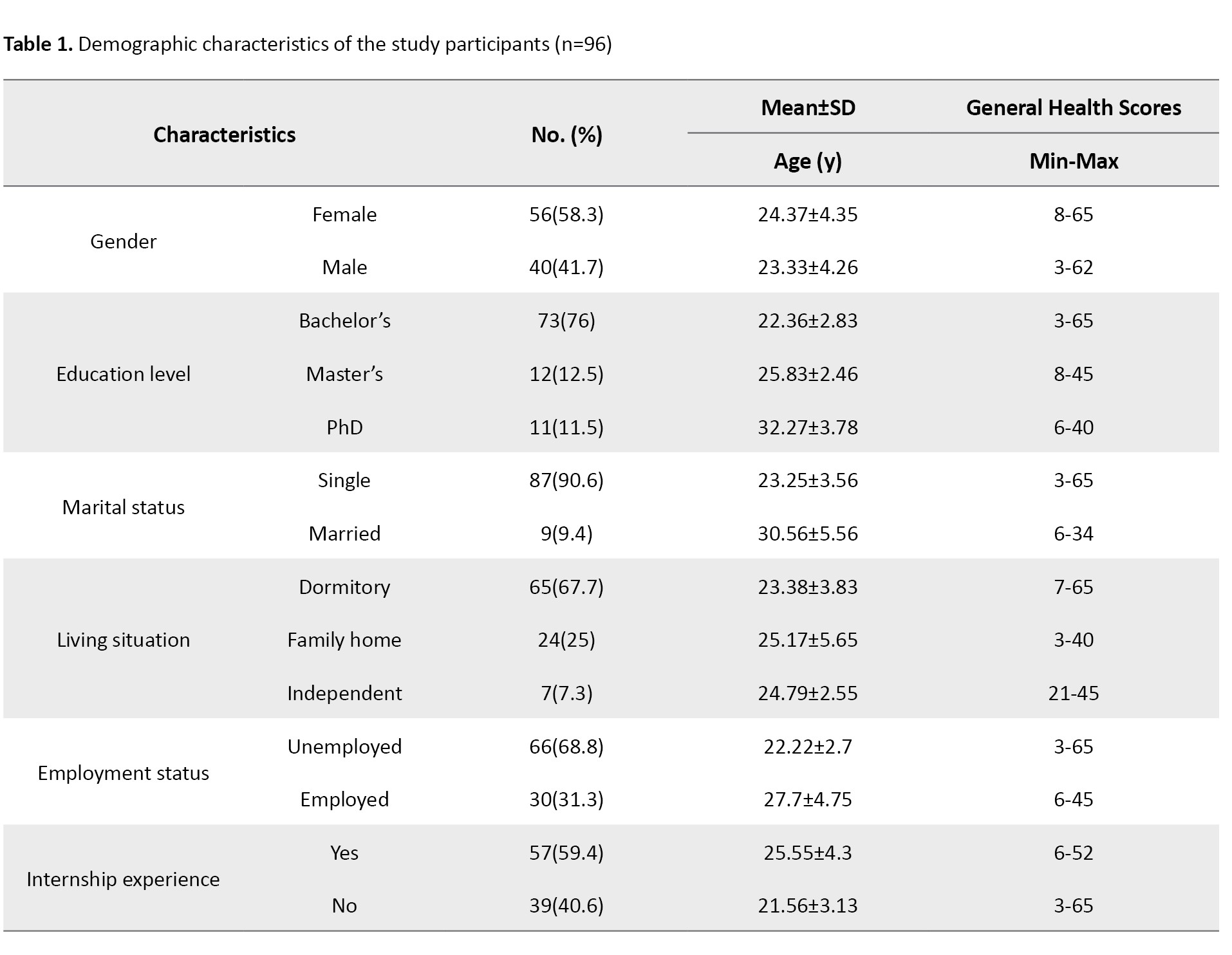
A total of 96 OT students from the Iran University of Medical Sciences, including undergraduate, master’s, and PhD students aged 18–38, participated in this study. Based on the result, 54 participants (56.25%) were at risk for general health disorders. Table 1 provides the demographic characteristics of the participants.
The assessment of regression assumptions confirmed that the relationship between the independent variables and the dependent variable was linear. Moreover, the analysis of residual plots and relevant tests demonstrated homoscedasticity and normality of residuals (the Kolmogorov-Smirnov test: P>0.05). In addition, the variance inflation factor values for all independent variables were below 10, indicating the absence of multicollinearity. Based on the results of multiple linear regression analysis (Table 2), a significant relationship was found between students’ health scores and certain variables.
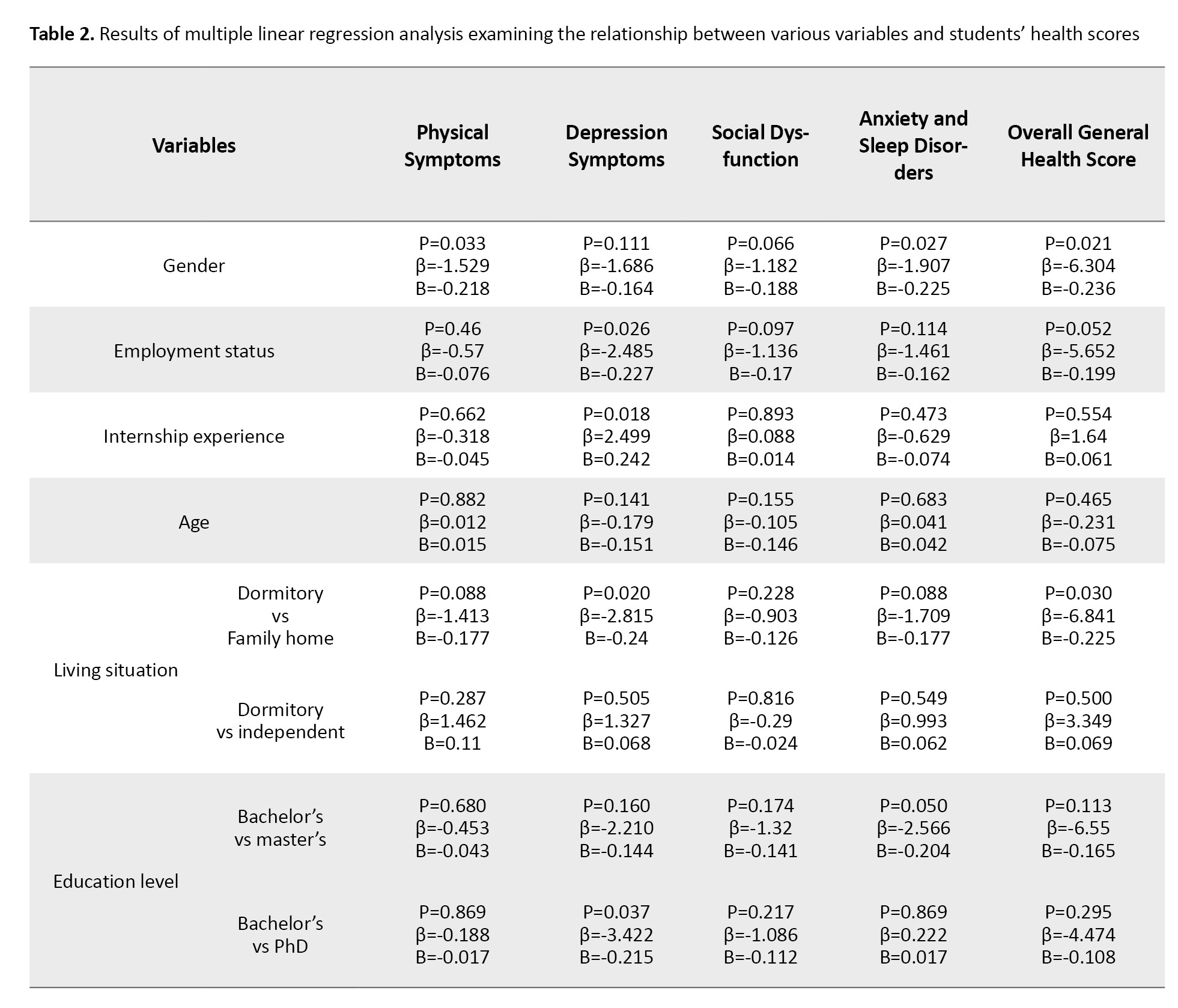
Likewise, a significant association was found between gender and the overall general health score (P=0.021, B=-6.304), physical symptoms (P=0.033, B=-1.529), and symptoms of anxiety and sleep disorders (P=0.027, B=-1.907). Specifically, being female was associated with higher scores in these domains of the GHQ-28 questionnaire. Although this association was also observed for depressive symptoms (P=0.111, B=-1.686) and social dysfunction (P=0.066, B=-1.182), it did not reach statistical significance (Table 2).
The relationship between age and various sections of the overall general health score (P=0.465, B=-0.231), physical symptoms (P=0.882, B=0.012), social dysfunction (P=0.155, B=-0.105), depression symptoms (P=0.141, B=-0.179), and anxiety and sleep disorders (P=0.683, B=0.041) revealed that although the scores varied with increasing age, these changes lacked statistical significance. A more detailed analysis across age groups of 18–20, 20–22, 22–24, 24–30, and over 30 years identified a statistically significant difference in physical symptoms (P=0.046, β=5.165, Std. B=0.226) between students aged 20–22 years and those aged 18–20 years. Table 2 presents the detailed findings on the relationship between age and different aspects of the overall general health score.
Considerable associations were noted between place of residence and general health scores, physical symptoms, social dysfunction, depression symptoms, anxiety, and sleep disorder symptoms. Students living with their families at home had mean scores 6.841 and 2.815 points lower in the general health and depression sections, respectively, compared to dormitory students (P=0.030, B=-6.841 and P=0.020, B=-2.815). This association was not significant in the other dimensions of physical symptoms, social dysfunction, anxiety, and sleep disorder symptoms. No significant differences were observed between dormitory students and those living independently at home (Table 2).
There was a significant association between internship experience and depression symptoms (P=0.018, B=2.499). More precisely, students without internship experience had depression scores 2.499 higher than those with internship experience. The relationship between internship experience and other sections of the GHQ-28 questionnaire was not significant (Table 2).
Discussion
This study assessed the health status of OT students at Iran University of Medical Sciences. OT students often encounter stress, anxiety, and even burnout during their studies [17]. Our findings revealed that more than half of the participants were suspected of having general health disorders. Additionally, the results revealed a statistically significant relationship between gender and health status, with males reporting higher health levels than females. In a study by Marcén-Román et al. [18], it was found that during the resumption of in-person classes after the COVID-19 pandemic, over 90% of students reporting high levels of stress were female. Biological factors, environmental stressors, and females’ heightened sensitivity to their surroundings can predispose female students to emotional and psychological problems [19].
Additionally, various factors (e.g. different cultural and social attitudes toward genders and women’s lower access to resources and opportunities) can result in higher vulnerability in health indicators compared to men [20], which contradicts the results of studies conducted in Rafsanjan and Hormozgan [12, 13], where gender did not play a determining role in health. Furthermore, the results of this study did not match the findings of research conducted by Farahangiz et al. [21], where male medical students reported higher levels of disorders. Factors related to the field of study or other variables (e.g. the location of study and the prevalence of the coronavirus disease 2019 pandemic) may explain the differences in results.
Examining the relationship between age and general health status, our results demonstrated no significant association between age and the physical and mental health of students, which is consistent with the findings of Sedighi et al. [13]. However, when the health components of the GHQ-28 questionnaire were analyzed for different age groups, a significant difference was observed in the physical symptom scores between students aged 18–20 years and those aged 20–22 years. Students aged 20–22 years reported higher physical symptom scores, indicating greater physical distress in this age group compared to younger students. It is noteworthy that students aged 20–22 years are primarily undergoing intensive internships in university-affiliated hospitals and clinics, which may explain the physical stress and the lack of familiarity with proper posture while working with patients as potential contributing factors to this issue. Musculoskeletal problems related to the work environment are a significant concern for occupational therapists and student interns, warranting further investigation and the development of preventive strategies [22].
The findings of this study are consistent with those of studies by Hosseini et al. [23] at Hamadan University of Medical Sciences and Shojaei et al. [24] at Shahid Beheshti University, both of which highlight a significant association between living in dormitories and mental health disorders among students. The results showed that overall general health scores and symptoms of depression were higher among dormitory students compared to those living at home with their families, indicating the greater vulnerability of dormitory students. Being away from family, receiving less emotional support, and having more responsibilities may contribute to this outcome. Moreover, no significant difference in mental health status was found when dormitory students were compared with those living independently at home without their families. This result contradicts the findings of Jacob et al. [25], reporting that living alone was associated with a higher likelihood of mental disorders; the discrepancy may be explained by the small number of students in our sample who lived independently.
Additionally, the results confirmed a significant association between internship experience and depression symptoms, with students without internship experience reporting higher levels of depression. Under the OT curriculum, internships typically start in the final two years of undergraduate study and continue in the subsequent master’s and doctoral tracks. First-year university students face considerable pressure to adapt to the new environment and manage academic performance, assignments, and exams. Moreover, these students are uncertain about their academic and career future, experiencing higher stress and anxiety, potentially exacerbating depression symptoms during this period [26], which corroborates the findings of the study by Janatolmakan et al. [27], showing that a high percentage of first-year nursing students reported depression symptoms.
The results of this study, consistent with those of Grab et al. [28], revealed a significant association between education level and depression scores among students, with undergraduate students experiencing higher levels of depression. Compared to the length of the undergraduate program and students’ inability to balance study and life, they reported that the high volume of coursework was a significant reason for high stress among undergraduate students [28]. As previously mentioned, undergraduates who are at the beginning of their academic journey experience high levels of anxiety due to various factors (e.g. uncertainty about their academic and career future and difficulties adapting to the new environment), which can lead to exacerbated depression symptoms. On the other hand, undergraduate interns in previous studies pointed to issues related to the treatment environment (e.g. inadequate workspace and lack of sufficient facilities, improper planning in clinics) and those associated with the performance of supervisors (e.g. lack of commitment to student education, unprofessional behavior with students in front of patients, and lack of punctuality in the educational environment). They also reported experiences such as a lack of a distinct professional identity within the treatment team and insufficient recognition of the OT profession and its significant role in the health system in the community, leading to dissatisfaction [29, 30]. These factors can help explain the psychological symptoms experienced by students during this period.
The relationship between students’ employment status and health showed a significant association between depression scores and employment status, with employed students reporting lower depression scores. Based on the findings of Grab et al. [28], economic problems and concerns are factors that threaten students’ mental health. Employment not only reduces the psychological pressures caused by economic problems but also fosters self-reliance, increases self-esteem, and enhances life satisfaction among students.
Conclusion
The present study examined the health status of OT students at Iran University of Medical Sciences and its association with various dimensions. More than half of the OT students at Iran University of Medical Sciences were suspected of having disorders in different dimensions of health. This finding underscores the need for a comprehensive examination of this issue and the establishment of more supportive structures and environments to improve the conditions of OT students in their academic and professional settings.
Study limitations
The study population was limited to OT students at Iran University of Medical Sciences, and the results lack a comparative analysis with similar studies conducted in different regions of Iran or other countries. Such an analysis could provide a more comprehensive understanding of the health challenges faced by OT students at both the national and global levels. Therefore, further studies with larger sample sizes are necessary to identify the factors affecting the health of OT students. It is recommended that future research use effective strategies to improve the well-being of these students.
Ethical Considerations
Compliance with ethical guidelines
This study was approved by the Ethics Committee of Iran University of Medical Sciences, Tehran, Iran (Code: IR.IUMS.REC.1404.438).
Funding
This research did not receive any grant from funding agencies in the public, commercial, or non-profit sectors.
Authors' contributions
Conceptualization: Samira Boroumand and Kiana Mahmoudian; Methodology: Samira Boroumand; Data curation: Kiana Mahmoudian; Investigation: Kiana Mahmoudian; Project administration: Samira Boroumand; Formal analysis: Samira Boroumand; Writing the original draft: Kiana Mahmoudian; Review, and editing: Samira Boroumand; Final approval: All authors;Supervision: Samira Boroumand.
Conflict of interest
The authors declared no conflict of interest.
Acknowledgments
The authors sincerely appreciate all the students who cooperated and supported hem in performing this research.
References
The issue of health has been a concern since the inception of humanity. Nonetheless, it has traditionally been considered primarily in physical terms, with less attention given to other dimensions, particularly mental health [1]. As a key indicator of overall community well-being, mental health plays a crucial role in ensuring the dynamism and efficiency of any society [2]. Mental health is defined as behavior that aligns with societal norms, recognition and acceptance of social realities, the ability to adapt to them, and the flourishing of innate talents [2]. Additionally, mental health encompasses feelings of well-being, self-efficacy, self-reliance, competitive capacity, and the actualization of one’s intellectual and emotional potential [3]. It can be influenced during different stages of life, including the university period, which is an exciting and challenging time for students [4]. Moreover, it often involves significant changes in social and personal relationships, making it a sensitive period for the young and productive workforce of any country. Due to the unique conditions of university life, including being away from family, entering a large and often stressful environment, facing economic problems, having insufficient income, doing heavy coursework, and participating in intense competition, students are prone to experiencing mental health challenges [5]. Furthermore, the unfamiliarity of many students with the university environment upon entry, a lack of interest in their field of study, and difficulty adapting to new social settings can lead to mental health issues and decreased academic performance [4].
Students in health professions, including those in occupational therapy (OT), face additional pressures from the hospital environment and the challenges of addressing patients’ issues [6]. OT focuses on the physical, cognitive, psychological, and social dimensions of individuals, making it one of the most effective yet challenging fields of rehabilitation [7]. The diversity of clients in OT clinics exposes students to various physical and mental stresses, thereby necessitating both strong physical and mental resilience [8]. In Iran, in addition to common challenges, OT students face other issues, such as the lack of a distinct professional identity within the healthcare team and insufficient recognition of their profession’s critical role in the health system, which can further complicate their practice [9]. Similar to future specialists responsible for promoting public health, these individuals need optimal mental health and self-reliance for proper academic performance and, subsequently, enhanced service delivery. Therefore, assessing their mental health status and identifying and mitigating factors that threaten their well-being are of great importance [10].
In recent years, numerous studies have assessed the mental health status of medical students in Iran using standardized tests, such as the Goldberg general health questionnaire (GHQ) and the symptom checklist. Dibajnia and Bakhtiari evaluated the mental health status of students at the School of Rehabilitation, Shahid Beheshti University, Iran, and found that 31.6% of them suffered from mental disorders [11]. Likewise, a study by Imani et al. on nursing students at Hormozgan University of Medical Sciences, Iran, revealed that 36.8% of the samples were identified as potentially having mental health disorders [12]. Similarly, Sedighi et al. examined the mental health status of medical students at Rafsanjan University of Medical Sciences, Iran, reporting that age, gender, and marital status did not significantly affect the students’ mental health scores [13]. A similar study on 29 OT students at the University of Texas, USA, demonstrated that 66.4% experienced high levels of stress and were negatively impacted by mental health factors [14]. To the best of our knowledge, no study has specifically examined the mental health status of OT students in Iran. Accordingly, given the importance of assessing the health of OT students as part of the medical community, this study aims to evaluate their mental health status and associated factors at Iran University of Medical Sciences.
Materials and Methods
After receiving approval from the Ethics Committee of Iran University of Medical Sciences, Tehran, Iran, this cross-sectional study was conducted among 96 OT students enrolled in the School of Rehabilitation Sciences at Iran University of Medical Sciences. The sample size was determined based on Equation 1:
1. n=(z2×σ2)/E2
and previous research [15]. The inclusion criterion included being a student of OT at Iran University of Medical Sciences. On the other hand, students unwilling to participate were excluded from the investigation. Participants in this study were undergraduate, Master, and PhD students enrolled in the 2022-2023 academic year. They were included in the study after receiving the necessary explanations about the research plan and providing informed consent. Then, the participants were given instructions on how to complete the demographic questionnaire and the 28-item general health questionnaire (GHQ-28), with either printed or electronic versions provided for data collection. Next, SPSS software, version 28, was used for data analysis. The necessary assumptions were examined before performing the statistical tests. Subsequently, a multiple linear regression model was applied to assess the relationship between GHQ-28 scores (the dependent variable) and age, gender, place of residence, internship experience, and employment status (independent variables). A significance level of 0.05 was considered for all tests.
Study instruments
The research instrument in this study was GHQ-28, originally developed by Goldberg in 1972. GHQ is a psychological screening tool used to identify individuals with potential psychological disorders. The original version of this questionnaire consisted of 60 items, which underwent multiple revisions, resulting in shorter versions with 12, 28, and 37 items. The GHQ-28 utilized in this study consists of 4 subscales, each containing 7 items, assessing somatic symptoms, anxiety and insomnia, social dysfunction, and severe depression. The scoring method for this questionnaire follows a 4-point Likert-type scale (0, 1, 2, 3), yielding a maximum score of 21 per subscale and 84 overall. Previous research demonstrated that the Likert-type scoring method is preferable and is widely applied in mental health assessments. This questionnaire was first translated into Persian by Noorbala et al. (1999), with its reliability and validity subsequently confirmed. They determined that at the optimal cutoff score of 23, the questionnaire exhibited a sensitivity of 70.5% and a specificity of 92.3%. Accordingly, individuals scoring 23 or below were classified as mentally healthy, while those scoring 24 or higher were considered at risk for psychological disorders. A cutoff score of 6 was applied for each subscale. According to this scoring method, higher scores indicate poorer mental health [16].
Results
A total of 96 OT students from the Iran University of Medical Sciences, including undergraduate, master’s, and PhD students aged 18–38, participated in this study. Based on the result, 54 participants (56.25%) were at risk for general health disorders. Table 1 provides the demographic characteristics of the participants.
The assessment of regression assumptions confirmed that the relationship between the independent variables and the dependent variable was linear. Moreover, the analysis of residual plots and relevant tests demonstrated homoscedasticity and normality of residuals (the Kolmogorov-Smirnov test: P>0.05). In addition, the variance inflation factor values for all independent variables were below 10, indicating the absence of multicollinearity. Based on the results of multiple linear regression analysis (Table 2), a significant relationship was found between students’ health scores and certain variables.
Likewise, a significant association was found between gender and the overall general health score (P=0.021, B=-6.304), physical symptoms (P=0.033, B=-1.529), and symptoms of anxiety and sleep disorders (P=0.027, B=-1.907). Specifically, being female was associated with higher scores in these domains of the GHQ-28 questionnaire. Although this association was also observed for depressive symptoms (P=0.111, B=-1.686) and social dysfunction (P=0.066, B=-1.182), it did not reach statistical significance (Table 2).
The relationship between age and various sections of the overall general health score (P=0.465, B=-0.231), physical symptoms (P=0.882, B=0.012), social dysfunction (P=0.155, B=-0.105), depression symptoms (P=0.141, B=-0.179), and anxiety and sleep disorders (P=0.683, B=0.041) revealed that although the scores varied with increasing age, these changes lacked statistical significance. A more detailed analysis across age groups of 18–20, 20–22, 22–24, 24–30, and over 30 years identified a statistically significant difference in physical symptoms (P=0.046, β=5.165, Std. B=0.226) between students aged 20–22 years and those aged 18–20 years. Table 2 presents the detailed findings on the relationship between age and different aspects of the overall general health score.
Considerable associations were noted between place of residence and general health scores, physical symptoms, social dysfunction, depression symptoms, anxiety, and sleep disorder symptoms. Students living with their families at home had mean scores 6.841 and 2.815 points lower in the general health and depression sections, respectively, compared to dormitory students (P=0.030, B=-6.841 and P=0.020, B=-2.815). This association was not significant in the other dimensions of physical symptoms, social dysfunction, anxiety, and sleep disorder symptoms. No significant differences were observed between dormitory students and those living independently at home (Table 2).
There was a significant association between internship experience and depression symptoms (P=0.018, B=2.499). More precisely, students without internship experience had depression scores 2.499 higher than those with internship experience. The relationship between internship experience and other sections of the GHQ-28 questionnaire was not significant (Table 2).
Discussion
This study assessed the health status of OT students at Iran University of Medical Sciences. OT students often encounter stress, anxiety, and even burnout during their studies [17]. Our findings revealed that more than half of the participants were suspected of having general health disorders. Additionally, the results revealed a statistically significant relationship between gender and health status, with males reporting higher health levels than females. In a study by Marcén-Román et al. [18], it was found that during the resumption of in-person classes after the COVID-19 pandemic, over 90% of students reporting high levels of stress were female. Biological factors, environmental stressors, and females’ heightened sensitivity to their surroundings can predispose female students to emotional and psychological problems [19].
Additionally, various factors (e.g. different cultural and social attitudes toward genders and women’s lower access to resources and opportunities) can result in higher vulnerability in health indicators compared to men [20], which contradicts the results of studies conducted in Rafsanjan and Hormozgan [12, 13], where gender did not play a determining role in health. Furthermore, the results of this study did not match the findings of research conducted by Farahangiz et al. [21], where male medical students reported higher levels of disorders. Factors related to the field of study or other variables (e.g. the location of study and the prevalence of the coronavirus disease 2019 pandemic) may explain the differences in results.
Examining the relationship between age and general health status, our results demonstrated no significant association between age and the physical and mental health of students, which is consistent with the findings of Sedighi et al. [13]. However, when the health components of the GHQ-28 questionnaire were analyzed for different age groups, a significant difference was observed in the physical symptom scores between students aged 18–20 years and those aged 20–22 years. Students aged 20–22 years reported higher physical symptom scores, indicating greater physical distress in this age group compared to younger students. It is noteworthy that students aged 20–22 years are primarily undergoing intensive internships in university-affiliated hospitals and clinics, which may explain the physical stress and the lack of familiarity with proper posture while working with patients as potential contributing factors to this issue. Musculoskeletal problems related to the work environment are a significant concern for occupational therapists and student interns, warranting further investigation and the development of preventive strategies [22].
The findings of this study are consistent with those of studies by Hosseini et al. [23] at Hamadan University of Medical Sciences and Shojaei et al. [24] at Shahid Beheshti University, both of which highlight a significant association between living in dormitories and mental health disorders among students. The results showed that overall general health scores and symptoms of depression were higher among dormitory students compared to those living at home with their families, indicating the greater vulnerability of dormitory students. Being away from family, receiving less emotional support, and having more responsibilities may contribute to this outcome. Moreover, no significant difference in mental health status was found when dormitory students were compared with those living independently at home without their families. This result contradicts the findings of Jacob et al. [25], reporting that living alone was associated with a higher likelihood of mental disorders; the discrepancy may be explained by the small number of students in our sample who lived independently.
Additionally, the results confirmed a significant association between internship experience and depression symptoms, with students without internship experience reporting higher levels of depression. Under the OT curriculum, internships typically start in the final two years of undergraduate study and continue in the subsequent master’s and doctoral tracks. First-year university students face considerable pressure to adapt to the new environment and manage academic performance, assignments, and exams. Moreover, these students are uncertain about their academic and career future, experiencing higher stress and anxiety, potentially exacerbating depression symptoms during this period [26], which corroborates the findings of the study by Janatolmakan et al. [27], showing that a high percentage of first-year nursing students reported depression symptoms.
The results of this study, consistent with those of Grab et al. [28], revealed a significant association between education level and depression scores among students, with undergraduate students experiencing higher levels of depression. Compared to the length of the undergraduate program and students’ inability to balance study and life, they reported that the high volume of coursework was a significant reason for high stress among undergraduate students [28]. As previously mentioned, undergraduates who are at the beginning of their academic journey experience high levels of anxiety due to various factors (e.g. uncertainty about their academic and career future and difficulties adapting to the new environment), which can lead to exacerbated depression symptoms. On the other hand, undergraduate interns in previous studies pointed to issues related to the treatment environment (e.g. inadequate workspace and lack of sufficient facilities, improper planning in clinics) and those associated with the performance of supervisors (e.g. lack of commitment to student education, unprofessional behavior with students in front of patients, and lack of punctuality in the educational environment). They also reported experiences such as a lack of a distinct professional identity within the treatment team and insufficient recognition of the OT profession and its significant role in the health system in the community, leading to dissatisfaction [29, 30]. These factors can help explain the psychological symptoms experienced by students during this period.
The relationship between students’ employment status and health showed a significant association between depression scores and employment status, with employed students reporting lower depression scores. Based on the findings of Grab et al. [28], economic problems and concerns are factors that threaten students’ mental health. Employment not only reduces the psychological pressures caused by economic problems but also fosters self-reliance, increases self-esteem, and enhances life satisfaction among students.
Conclusion
The present study examined the health status of OT students at Iran University of Medical Sciences and its association with various dimensions. More than half of the OT students at Iran University of Medical Sciences were suspected of having disorders in different dimensions of health. This finding underscores the need for a comprehensive examination of this issue and the establishment of more supportive structures and environments to improve the conditions of OT students in their academic and professional settings.
Study limitations
The study population was limited to OT students at Iran University of Medical Sciences, and the results lack a comparative analysis with similar studies conducted in different regions of Iran or other countries. Such an analysis could provide a more comprehensive understanding of the health challenges faced by OT students at both the national and global levels. Therefore, further studies with larger sample sizes are necessary to identify the factors affecting the health of OT students. It is recommended that future research use effective strategies to improve the well-being of these students.
Ethical Considerations
Compliance with ethical guidelines
This study was approved by the Ethics Committee of Iran University of Medical Sciences, Tehran, Iran (Code: IR.IUMS.REC.1404.438).
Funding
This research did not receive any grant from funding agencies in the public, commercial, or non-profit sectors.
Authors' contributions
Conceptualization: Samira Boroumand and Kiana Mahmoudian; Methodology: Samira Boroumand; Data curation: Kiana Mahmoudian; Investigation: Kiana Mahmoudian; Project administration: Samira Boroumand; Formal analysis: Samira Boroumand; Writing the original draft: Kiana Mahmoudian; Review, and editing: Samira Boroumand; Final approval: All authors;Supervision: Samira Boroumand.
Conflict of interest
The authors declared no conflict of interest.
Acknowledgments
The authors sincerely appreciate all the students who cooperated and supported hem in performing this research.
References
- Hajebi A, Sharifi V, Abbasinejad M, Asadi A, Jafari N, Ziadlou T, et al. Integrating mental health services into the primary health care system: the need for reform in Iran. Iran J Psychiatry. 2021; 16(3):320-8. [DOI:10.18502/ijps.v16i3.6258]
- Sadeghian E, Heidarian Pour A. [Stressors and mental health status among students of Hamadan University of Medical Sciences (Persian)]. Hayat. 2009; 15(1):71-80. [Link]
- Nojomi M, Gharayee B. Medical students and mental health by SCL-90-R. Med J Islam Repub Iran. 2007; 21(2):71-8. [Link]
- Ansari H, Bahrami L, Akbarzadeh L, Bakhshani NM. [Assessment of general health and some related factors among students of Zahedan University of Medical Sciences in 2007 (Persian)]. Zahedan J Res Med Sci. 2008; 9(4):295-304. [Link]
- Zare N, Daneshpajooh F, Amini M, Razeghi M, Fallahzadeh MH. [The relationship between self-esteem, general health and academic achievement in students of Shiraz University of Medical Sciences (Persian)]. Iran J Med Educ. 2007; 7(1):59-67. [Link]
- Brown T, Yu ML, Hewitt AE, Isbel ST, Bevitt T, Etherington J. Exploring the relationship between resilience and practice education placement success in occupational therapy students. Aust Occup Ther J. 2020; 67(1):49-61. [DOI:10.1111/1440-1630.12622] [PMID]
- Zehra N. Transforming disability into ability: The niche of occupational therapy in the multi-rehabilitation team at healthcare services. Allied Med Res J. 2023; 1(2):1-2. [DOI:10.59564/AMRJ/01.02/001]
- Henderson A, Twentyman M, Heel A, Lloyd B. Students' perception of the psycho-social clinical learning environment: An evaluation of placement models. Nurse Educ Today. 2006; 26(7):564-71. [DOI:10.1016/j.nedt.2006.01.012] [PMID]
- Ghamari N, Derakhshanrad SA, Ghamari M, Ghamari E. [Examining the motivational power of occupational therapy profession among occupational therapist in Fars providence in 1390 (Persian)]. Mod Rehabil. 2012; 6(3):5-12. [Link]
- Ebrahimi S, Kargar Z. Occupational stress among medical residents in educational hospitals. Ann Occup Environ Med. 2018; 30:51. [DOI:10.1186/s40557-018-0262-8] [PMID]
- Dibajnia P, Bakhtiari M. [Mental health status of the students in the faculty of rehabilitation, Shahid Beheshti University, 2002 (Persian)]. J Ardabil Univ Med Sci. 2002; 1(4):27-32. [Link]
- Imani E, Khademi Z, Soudagar S, Naghizadeh F. [Health status of nursing students of Hormozgan University of medical sciences by Goldberg’s general health questionnaire-2011 (Persian)]. Hormozgan Med J. 2013; 17(4):320-7. [Link]
- Sedighi E, Bidaki R, Meidani A, Ahmadinia H, Rezaeian M. [Mental health status in medical students of Rafsanjan University of Medical Sciences in 2016 (Persian)]. J Rafsanjan Univ Med Sci. 2018; 17(7):669-80. [Link]
- Pfeifer TA, Kranz PL, Scoggin AE. Perceived stress in occupational therapy students. Occup Ther Int. 2008; 15(4):221-31. [DOI:10.1002/oti.256] [PMID]
- Namazi A, Alizadeh Sh, Kouchakzadeh Talami S. [General health in nursing and midwifery students and its relationship with academic achievement (Persian)]. J Nurs Educ. 2015;4(3):11-8. [Link]
- Noorbala AA, Bagheri Yazdi SA, Mohammad K. [The Validation of General Health Questionnaire- 28 as a psychiatric screening tool (Persian)]. Hakim. 2009; 11(4):47-53. [Link]
- Laposha I, Smallfield S. Self-care: An occupational therapy student perspective. J Occup Ther Educ. 2022; 6(1):5. [DOI:10.26681/jote.2022.060105]
- Marcén-Román Y, Gasch-Gallen A, Vela Martín de la Mota II, Calatayud E, Gómez-Soria I, Rodríguez-Roca B. Stress perceived by university health sciences students, 1 year after COVID-19 pandemic. Int J Environ Res Public Health. 2021; 18(10):5233. [DOI:10.3390/ijerph18105233] [PMID]
- Ferdosi T, Zeinivand Y, Rezazadeh SMR. [A comparison of the mental health of dormitory versus non-dormitory students of Shahid Madani University in Azerbaijan (Persian)]. Woman Stud Fam. 2012; 4(16):127-42. [Link]
- Alizadeh A, Danesh P, Maleki A, Javaheri F. [Social factors affecting the mental health of women compared to men (Persian)]. Womens Stud Sociol Psychol. 2023; 21(1):121-49. [DOI:10.22051/jwsps.2023.38998.2565]
- Farahangiz S, Mohebpour F, Salehi A. Assessment of mental health among Iranian medical students: A cross-sectional study. Int J Health Sci (Qassim). 2016; 10(1):49-55. [DOI:10.12816/0031216] [PMID]
- Morabito J, Penkala S, Coxon K. Workplace musculoskeletal problems in occupational therapy students. BMC Public Health. 2021; 21(1):660. [DOI:10.1186/s12889-021-10653-8] [PMID]
- Hosseini SM, Sarhady M, Nurani Gharaborghe S. [Correlation of time use with health-related quality of life in dormitory students (Persian)]. J Health Promot Manag. 2019; 8(3):46-52. [Link]
- Shojaei SH, Kalantari M, Rezaee M, Akbarzadeh Baghban A. [Relationship between work-life balance and quality of life in dormitory and non-dormitory students of Shahid Beheshti University of Medical Sciences (Persian)]. Sci J Rehabil Med. 2022; 11(1):40-51. [DOI:10.32598/SJRM.11.1.4]
- Jacob L, Haro JM, Koyanagi A. Relationship between living alone and common mental disorders in the 1993, 2000 and 2007 National Psychiatric Morbidity Surveys. PLoS One. 2019; 14(5):e0215182. [DOI:10.1371/journal.pone.0215182] [PMID]
- Rezaee M, Rassafiani M, Khankeh H, Hosseini MA. Experiences of occupational therapy students in the first fieldwork education: A qualitative study. Med J Islam Repub Iran. 2014; 28:110. [PMID]
- Janatolmakan M, Andaieshgar B, Aryan A, Jafari F, Khatony A. Comparison of depression rate between the first-and final-year nursing students in Kermanshah, Iran. Psychol Res Behav Manag. 2019; 12:1147-53. [DOI:10.2147/PRBM.S238873] [PMID]
- Grab J, Green M, Norris J, Pilchik K, Fisher GS. Exploring occupational therapy student stress: professor and student perspectives. J Occup Ther Educ. 2021; 5(1):3. [DOI:10.26681/jote.2021.050103]
- Pashmdarfard M, Shafaroodi N, Mehraban AH, Arabshahi KS, Parvizy S. Barriers to occupational therapy fieldwork education in Iran: The perspectives of fieldwork educators and students. Iran J Nurs Midwifery Res. 2021; 26(3):204-9. [DOI:10.4103/ijnmr.IJNMR_206_20] [PMID]
- Pashmdarfard M, Hassani Mehraban A, Shafaroodi N, Soltani Arabshahi K, Parvizy S. Strategies to promote the quality of occupational therapy fieldwork education: A qualitative study. Med J Islam Repub Iran. 2022; 36(1):209-16. [DOI:10.47176/mjiri.36.27]
Type of Study: Research |
Subject:
Occupational Therapy
Received: 2025/07/31 | Accepted: 2025/10/20 | Published: 2025/11/10
Received: 2025/07/31 | Accepted: 2025/10/20 | Published: 2025/11/10
Contact Information

All the work in this journal are licensed under a Creative Commons
ATTRIBUTION-NONCOMMERCIAL-SHAREALIKE 4.0
INTERNATIONAL International License.
Tehran Province, Tehran, District 3, Mirdamad Ave, Nezam Ave, School of Rehabilitation Science
Tel: +98 21 22228051-2 Ext: 180
Fax98 21 22220946
All the work in this journal are licensed under a Creative Commons
ATTRIBUTION-NONCOMMERCIAL-SHAREALIKE 4.0
INTERNATIONAL International License.